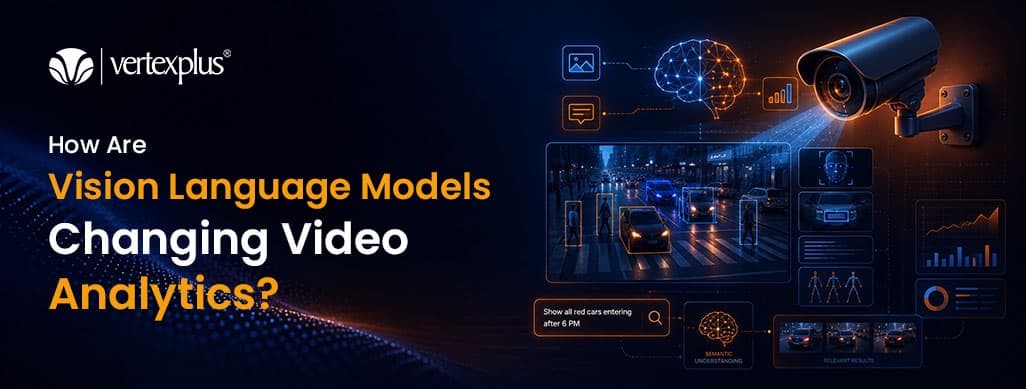
VLMs make footage searchable and interpretable through natural-language prompts, moving video analytics beyond rigid detection into business intelligence.
Vision language models (VLMs) are fundamentally transforming video analytics by making footage searchable and interpretable through natural-language prompts, moving beyond traditional detection-based systems. Rather than requiring a separate model for each object or event type, businesses can now query video directly using conversational questions.
Market momentum
The sector is growing fast. The AI-powered video surveillance analytics market reached roughly $7 billion in 2024 and is projected to expand to about $38-42 billion by 2034, nearly 19% annual growth. That reflects rising demand for real-time threat identification, behavioral analysis, cloud platforms, and smart-city applications. Video analytics is shifting from a specialized security tool into an enterprise-wide operational platform.
From detection to understanding
- Understanding, not just detection, VLMs interpret scenes, actions, and relationships rather than only identifying objects.
- Faster search and review, natural-language queries replace manual footage scrubbing.
- More flexible use cases, VLMs adapt across retail, manufacturing, hospitality, and logistics without extensive retraining.
- Better context for decisions, combined visual and language reasoning reduces misclassification.
- Stronger enterprise value, less manual monitoring, faster investigation, and structured business intelligence from raw video.
Why VLMs matter
VLMs bridge the gap between raw video and business language. Organizations don’t need alerts that simply say “person detected”, they need contextual explanations like “unauthorized entry near the loading dock after hours.” That alignment with real workplace language and decision-making is a major advantage in dynamic environments.
Proof in the field
Netflix’s Video Annotator framework showed that VLMs combined with active learning substantially improve video classification efficiency, an 8.3-point Average Precision improvement across 56 labels and 500,000 video segments, while keeping human experts in the loop for hard cases. NVIDIA documented Pegatron’s VLM-based manufacturing analytics achieving a 7% reduction in labor cost and a 67% decrease in defect rates per assembly line.
How to implement
- Define the use case and performance objectives.
- Audit camera coverage and privacy constraints.
- Select an appropriate edge-cloud-human architecture.
- Pilot with a limited set of prompts and tasks.
- Measure accuracy and business impact before scaling.
Challenges and risks
VLMs have documented limits with spatial understanding, small-object detection, and long-duration reasoning. Human oversight remains essential, the most effective deployments combine automation for scanning with human review for final decisions, preventing overconfidence in system outputs.
Conclusion
Vision language models are evolving video analytics from narrow detection tools into flexible business-intelligence platforms. Organizations that combine VLMs with strong governance, domain expertise, and quantifiable operational objectives will realize the greatest benefits.
Frequently asked questions
- What are VLMs in video analytics?
- AI systems combining visual understanding with language capabilities, enabling natural-language video search, summarization, and interpretation rather than relying solely on fixed labels.
- How do VLMs differ from traditional systems?
- Traditional approaches detect predefined objects; VLMs understand broader context, answer questions, and adapt more readily to new scenarios.
- Which industries benefit most?
- Retail, logistics, manufacturing, hospitality, transportation, and enterprise security, sectors generating large video volumes that need rapid contextual analysis.